Collect
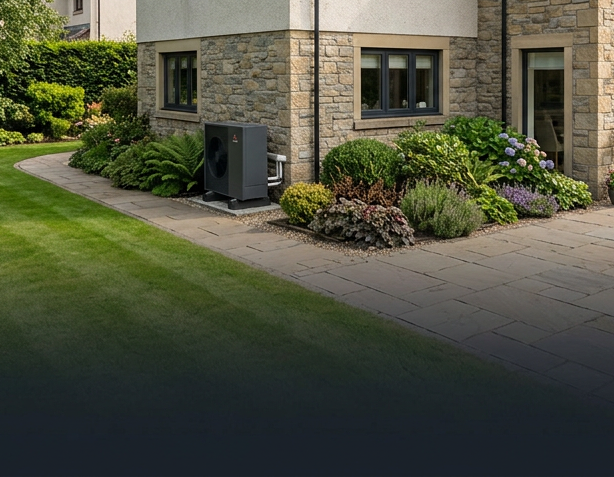
The outdoor unit draws air across a heat exchanger containing refrigerant, which absorbs heat even when the air feels cold.

The 2026 Scottish Homeowner Guide
How air source heat pumps work, what they cost, how Scottish funding operates and what determines whether a system will perform properly in your home.
Reviewed and updated September 2026
The Short Answer
Yes. Air source heat pumps can extract useful heat from outdoor air at temperatures well below freezing. Their success in a Scottish home depends less on the weather than on accurate heat-loss calculations, suitable emitters, sensible flow temperatures, correct controls and the quality of the installation.
A heat pump should not be treated as a direct boiler swap. It is part of a complete heating system that must be designed around the property.
How the Technology Works
An air-to-water heat pump uses electricity to transfer naturally occurring heat from the outdoor air into the water circulating through your radiators, underfloor heating and hot-water cylinder.
The outdoor unit draws air across a heat exchanger containing refrigerant, which absorbs heat even when the air feels cold.
A compressor raises the refrigerant pressure and temperature, making the captured heat useful for the home.
The system transfers that heat into water serving the heating circuit and, where designed to do so, domestic hot water.
Weather compensation and system controls adjust flow temperature so the home is heated steadily and efficiently.
Is Your Home Suitable?
Old, new, detached, semi-detached and rural homes can all use heat pumps. Suitability cannot be judged from the age of the property or its EPC band alone.
A room-by-room calculation establishes how much heat the home needs at the local design temperature and prevents guesswork over heat-pump capacity.
Radiators, underfloor heating, pipework and flow rates must deliver the required output at the proposed operating temperature.
The survey should identify a suitable outdoor position, cylinder and control space, pipe routes, drainage, airflow and maintenance access.
The installer must review the supply, consumer equipment, protective devices and any network-notification requirements.
Comfort expectations, hot-water demand, occupancy and preferred control strategy all influence the final system design.
Air Source Heat Pump Costs
A useful price must cover the whole heating system—not only the outdoor unit. Energy Saving Trust currently gives an approximate UK installation figure of around £12,000, but individual Scottish projects can fall below or above this.
Size, fabric, exposure and design temperature affect the required capacity.
Radiators, pipework, cylinders and controls may require alteration or replacement.
Equipment position, access, electrical work and ground or wall preparation affect labour.
Heat-pump model, capacity, hot-water storage and control strategy shape the final proposal.
Smart Group should only provide a firm project price after assessing the property and establishing the required system specification.
Efficiency and Running Costs
It can be, but no responsible installer should promise the same saving for every home. The result depends on system efficiency, electricity prices and the heating system being replaced.
A heat pump can provide several units of heat for each unit of electricity it uses. Seasonal performance is more useful than a single laboratory figure because it reflects operation across the heating year.
Heat pumps usually perform best when maintaining a steady temperature rather than repeatedly heating a cold property at maximum output.

The Complete Heating System
Heat pumps can work with radiators. Underfloor heating is not compulsory. The real question is whether each room can receive enough heat at an efficient water temperature.
Some existing radiators may be adequate; others may need to be larger or changed to higher-output models. This should follow calculation rather than blanket replacement.
Pipe sizes and flow rates must be checked. Restrictive sections can prevent the system from moving enough heat even when the heat pump is correctly sized.
A home does not need to be new or perfect, but sensible insulation and draught improvements reduce heat loss, required capacity and running cost.
Lower flow temperatures generally improve efficiency. The emitters and controls should be designed so comfort is maintained without unnecessary temperature.
Home Energy Scotland
in grant support for eligible heat-pump installations, with a potential rural uplift.
The Home Energy Scotland Grant and Loan currently offers Scottish homeowners grant funding of up to £7,500 for eligible clean-heating systems, with an optional interest-free loan of up to £7,500. Higher grant support may apply to qualifying rural and island postcodes.
Funding rules, eligibility, approved measures and available budgets can change. Apply and receive a written funding offer before work begins where the scheme requires it.
Check Current Home Energy Scotland FundingPosition, Planning and Sound
The unit requires unobstructed airflow, service access, a stable base and a position that considers occupants, neighbours, drainage and visual impact.
Avoid enclosed spaces and obstructions that could encourage cold-air recirculation.
Model, output, mounting and distance from windows or neighbouring homes all matter.
Defrost water must be managed safely to avoid nuisance or icing around the unit.
Scottish permitted-development rules contain limitations, particularly for listed buildings and sensitive locations.
Many domestic installations can fall within permitted-development rights, but this is not automatic. The proposal should be checked against current Scottish rules and the specific property. Planning permission or additional consent may be required.
From Survey to Handover
The visible outdoor unit is only one part of the project. Most of the value lies in the survey, calculation, design and commissioning behind it.
Discuss the home, existing heating, energy use, occupancy, hot water and the outcome you want.
Measure the property, inspect fabric and emitters, review equipment locations and assess the electrical supply.
Calculate room-by-room demand at the appropriate external design temperature.
Select the heat pump, emitters, cylinder, hydraulic arrangement, controls and target flow temperatures.
Set out the scope, assumptions, predicted performance, cost and any funding documentation.
Remove or adapt existing equipment, complete heating and electrical work and prepare the outdoor-unit position.
Test flow, controls, hot water, weather compensation, performance and safe system operation.
Explain controls and everyday operation, provide documentation and establish servicing arrangements.
Ownership and Maintenance
A well-designed heat pump should provide steady background warmth. It normally operates for longer periods at a lower temperature than a boiler, so the controls and expectations are different.
| What to monitor | Good practice | When to ask for help |
|---|---|---|
| Outdoor unit | Keep airflow clear of leaves, vegetation and stored items. | Persistent icing, unusual noise or visible damage. |
| Pressure and flow | Follow the installer’s guidance and note unexpected changes. | Repeated pressure loss, flow errors or rooms failing to heat. |
| Controls | Use stable schedules and avoid frequent large temperature changes. | Repeated overrides or excessive reliance on direct-electric backup. |
| Annual service | Arrange servicing in line with manufacturer and warranty requirements. | Performance has declined or energy use changes unexpectedly. |
Questions and Answers
Straight answers to the questions Scottish homeowners ask most often.
Yes. Modern air source heat pumps are designed to extract heat at temperatures below freezing. Performance changes with outdoor temperature, which is why the system must be sized using an appropriate local design temperature and the home’s calculated heat loss.
Yes, many older properties are suitable. Age alone is not the deciding factor. Heat loss, insulation, draughts, radiator output, pipework and available equipment positions must be assessed.
No. Heat pumps can work effectively with properly sized radiators. Underfloor heating can operate efficiently at lower temperatures, but it is not a requirement.
Not necessarily. A room-by-room assessment should compare each radiator’s output at the proposed flow temperature with that room’s calculated heat loss. Only inadequate emitters need attention.
They produce fan and compressor sound, but correct product selection, mounting and location should keep this within the applicable design and planning requirements. Sound should be considered before installation, not after it.
It depends on the heat pump’s seasonal efficiency, required flow temperature, electricity tariff and the efficiency and fuel cost of the system being replaced. A saving should be modelled for the individual home rather than guaranteed.
Yes, an appropriately designed air-to-water heat pump system can provide domestic hot water through a suitable cylinder. Cylinder capacity, household demand and control settings need to be included in the design.
A well-installed and maintained heat pump can commonly operate for around 20 years, although actual service life depends on the product, operating conditions and maintenance.
An annual professional service is generally sensible and may be required by the manufacturer or warranty. Follow the requirements supplied with the installed system.
Check the current scheme and obtain the required written funding offer before work starts. Beginning work too early can affect eligibility.
Start With a Technical Assessment
Smart Group will assess the property, heating demand, existing system and practical installation requirements before recommending a solution.