Measure Demand
Map when and how much electricity the site consumes, including weekdays, weekends and seasonal changes.

The 2026 Scottish Business Guide
A practical guide to commercial solar PV costs, savings, roof suitability, grid connections, finance and installation for businesses, farms and organisations across Scotland.
Reviewed and updated September 2026
The Short Answer
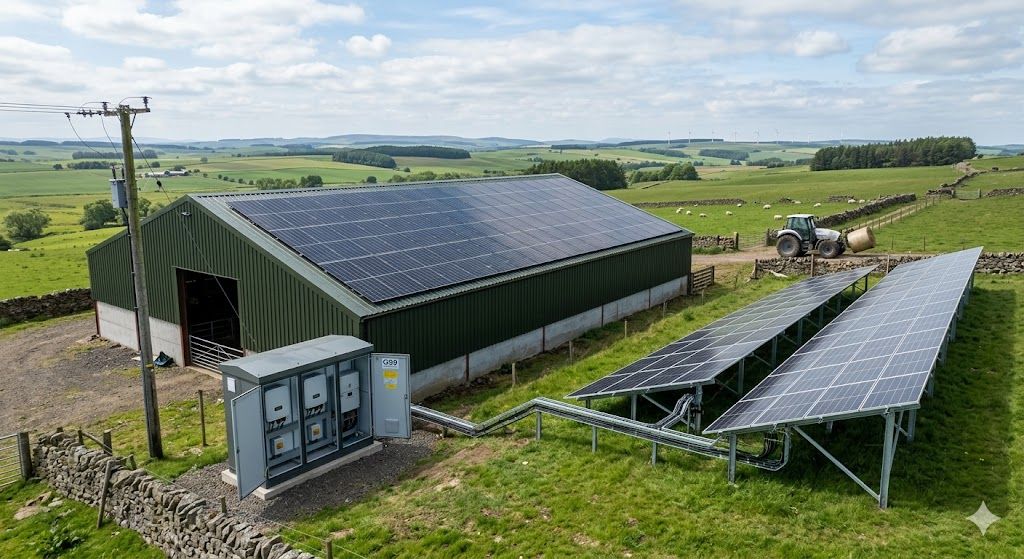
It can be—particularly where a business has suitable roof or land and uses a meaningful amount of electricity during daylight hours. The strongest projects use a high proportion of their solar generation on site, replacing electricity that would otherwise be bought from the grid.
The decision should be based on a site-specific generation model, actual electricity data, connection requirements, project cost and a clearly stated set of assumptions. A headline system size or generic percentage saving is not enough.
Property & Energy Use
Suitability depends on more than roof area. The building, electricity profile, electrical infrastructure, planning context and grid connection all shape what can be installed.
The remaining life of the roof should be considered alongside the expected life of the solar array. A structural engineer may need to confirm that the roof and supporting structure can accept the additional loads and wind forces.
South-facing roofs can produce strong annual generation, but east–west layouts may fit more panels and spread output across the working day. Rooflights, vents, parapets, nearby buildings and trees must be modelled rather than ignored.
Factories, farms, offices, care facilities, hotels, schools, shops and refrigeration-led businesses can be well suited because they often consume electricity while the panels are generating.
Design Before Equipment
The biggest array that fits is not automatically the best commercial design. Capacity should follow the organisation’s objectives and the evidence available.
Map when and how much electricity the site consumes, including weekdays, weekends and seasonal changes.
Estimate monthly and annual output using roof orientation, pitch, shading, local irradiation and system losses.
Calculate likely on-site use and export instead of assuming every generated unit saves the full import price.
Check roof loading, electrical capacity, DNO limits, planning considerations, access and future energy plans.
Budget & Business Case
Commercial projects are not priced reliably from panel count alone. Scale can reduce the installed cost per kilowatt, but access, roof works, switchgear and grid requirements can materially change the total.
| Cost or value factor | What changes it | What a proposal should show |
|---|---|---|
| Solar PV equipment | Panel, inverter, mounting and monitoring specification | Named products, quantities, warranties and expected system capacity |
| Roof and access work | Roof type, height, edge protection, scaffolding, lifting and fragile surfaces | What is included, excluded and subject to survey |
| Electrical works | Cable routes, distribution boards, metering, transformers and switchgear | Connection point, protection design and any enabling work |
| Grid connection | DNO study, export limit and required network reinforcement | Application route, assumed export capacity and provisional charges |
| Project delivery | Design, structural input, permissions, commissioning and documentation | A clear scope with responsibilities and programme |
Electricity used directly on site normally carries more value than exported electricity because it replaces the business import price.
Eligible generation may earn export revenue, but tariff rates and contract conditions vary and should not be assumed.
Long-term modelling should allow for gradual panel degradation, inverter replacement risk and maintenance.
A sound appraisal tests changes in electricity prices, generation, usage, downtime and finance costs.
Funding the Project
Each route changes ownership, risk, cash flow and the value retained by the business. Terms should be compared over the full contract period, not only by the first monthly payment.
The organisation buys and owns the system, retaining the generation benefit and accepting maintenance and performance risk. Tax treatment should be confirmed with its accountant.
Finance can spread the cost, subject to credit approval and lender terms. Compare the total amount repayable with conservative energy savings rather than assuming the project will always be cash-positive.
A third party may fund and own the equipment while the occupier buys generated electricity under a long-term agreement. Review indexation, roof obligations, change-of-occupier provisions and exit costs carefully.
Permissions & Connections
These workstreams should start early. A technically suitable roof does not by itself guarantee that the proposed export capacity can be connected or that planning permission is unnecessary.
Many commercial generators require approval before connection under Engineering Recommendation G99. The DNO may approve the design, limit export, request protection changes or identify network reinforcement.
Where unrestricted export is unavailable, a compliant G100 export-limitation scheme may allow generation to be controlled. The commercial effect should be reflected in the savings model.
Scotland has permitted development rights for many non-domestic solar installations, but limits and conditions apply. Conservation areas, listed buildings, designated land, unusual mounting and other site factors can change the position.
The design should coordinate structural safety, roof access, fire strategy, cable routes, isolation, signage, weatherproofing and safe future maintenance.
Solar Plus Storage
Not automatically. A battery can add value, but it introduces additional capital cost, conversion losses, power limits, degradation and safety requirements.
Storage may increase use of solar that would otherwise be exported, shift imported electricity away from expensive periods, manage demand peaks or support a specifically designed resilience strategy.
Backup is not an automatic feature of every battery system. Essential loads, changeover arrangements and available power must be designed explicitly.
Explore Battery Storage
From Feasibility to Handover
A well-managed project resolves commercial and technical risks before equipment arrives on site.
Clarify objectives, property details, tenancy or ownership, electricity costs and future operational changes.
Review bills, meter data and load profile to establish how generation may be used.
Inspect the roof, access, electrical infrastructure, cable routes, metering and potential equipment locations.
Develop the layout, generation model, electrical design, protection, monitoring and structural requirements.
Coordinate DNO approval, planning checks, landlord consent and other project-specific approvals.
Set out specification, scope, cost, programme, assumptions, exclusions and projected performance.
Plan access, safety and shutdowns to control disruption while the mechanical and electrical works are completed.
Test the system, complete connection documentation, configure monitoring and provide handover information.
Comparing Proposals
Comparable proposals should use comparable assumptions. Ask for the evidence behind the headline savings and payback figure.
Was the design based on actual interval data, annual bills or a generic consumption assumption?
Check scaffolding, lifting, roof repairs, structural work, switchgear, DNO charges and VAT.
Confirm shading, system losses, degradation, export and self-consumption assumptions.
Establish responsibility for design, permissions, installation, commissioning, monitoring and support.
Questions & Answers
Straight answers to the questions Scottish businesses commonly ask before commissioning a solar PV project.
There is no reliable universal price. System capacity, roof type, access, electrical infrastructure, DNO requirements, equipment and project scope all affect cost. Use an indicative budget only until the site and connection have been assessed.
Payback varies with installed cost, annual generation, on-site electricity use, import price, export revenue, maintenance, finance and tax treatment. A proposal should state every assumption and test less favourable scenarios.
Some unusual sites may achieve very high reductions, but this should never be treated as a general promise. Solar affects the electricity portion of the bill and savings depend on demand, usable installation area and how much generation is consumed on site.
It depends on the wattage of the selected panels. For example, panel count is calculated by dividing required array capacity by individual panel output, then checking that the layout is physically and electrically suitable.
Many installations may fall within permitted development rights, subject to limits and conditions. Listed buildings, conservation areas, designated locations and unusual proposals require particular care. Confirm the position for the individual site.
G99 is the engineering framework commonly used for connecting generation above the small-scale G98 route. The proposed system is submitted to the Distribution Network Operator for assessment before connection.
Potentially. An approved export-limitation arrangement can control export, but the DNO must accept the connection approach and any curtailed generation should be reflected in the commercial model.
Roof work can often be planned around normal activity, but electrical connection and commissioning may require controlled shutdowns. The programme and responsibilities should be agreed before installation begins.
No. Battery storage should be assessed separately against load data, tariffs, solar surplus and operational objectives. Many strong commercial projects work without storage because daytime demand already absorbs generation.
It may be possible with landlord and any lender consent. The lease, repair obligations, roof rights, reinstatement, insurance and treatment at lease end should be reviewed before commitment.
Quality panels commonly carry long product and performance warranties, but inverters and other components have different warranty periods and replacement expectations. The maintenance plan should cover the complete system.
Export arrangements are available, but eligibility, metering, contract terms and rates vary by supplier and system scale. Export revenue should be based on an obtainable offer rather than an assumed headline rate.
Build the Business Case Properly
Smart Group can assess the site, review electricity use and develop a commercial solar proposal around the technical and operational realities of your organisation.