Measure
Monitoring detects solar generation, household demand, grid import and export so the controller understands the energy balance.

The 2026 Scottish Homeowner Guide
How home batteries work, what they cost, how to choose the right capacity and when solar storage, grid charging or backup capability can genuinely improve a home-energy system.
Reviewed and updated September 2026

The Short Answer
It can be, but not for every household. A battery can increase solar self-consumption, shift grid purchases into cheaper tariff periods and provide selected backup when the system is specifically designed for it.
The outcome depends on electricity use, solar generation, tariff, usable battery capacity, charge and discharge power, conversion losses, warranty and installed cost. Those factors should be modelled together before choosing a system.
How Home Batteries Work
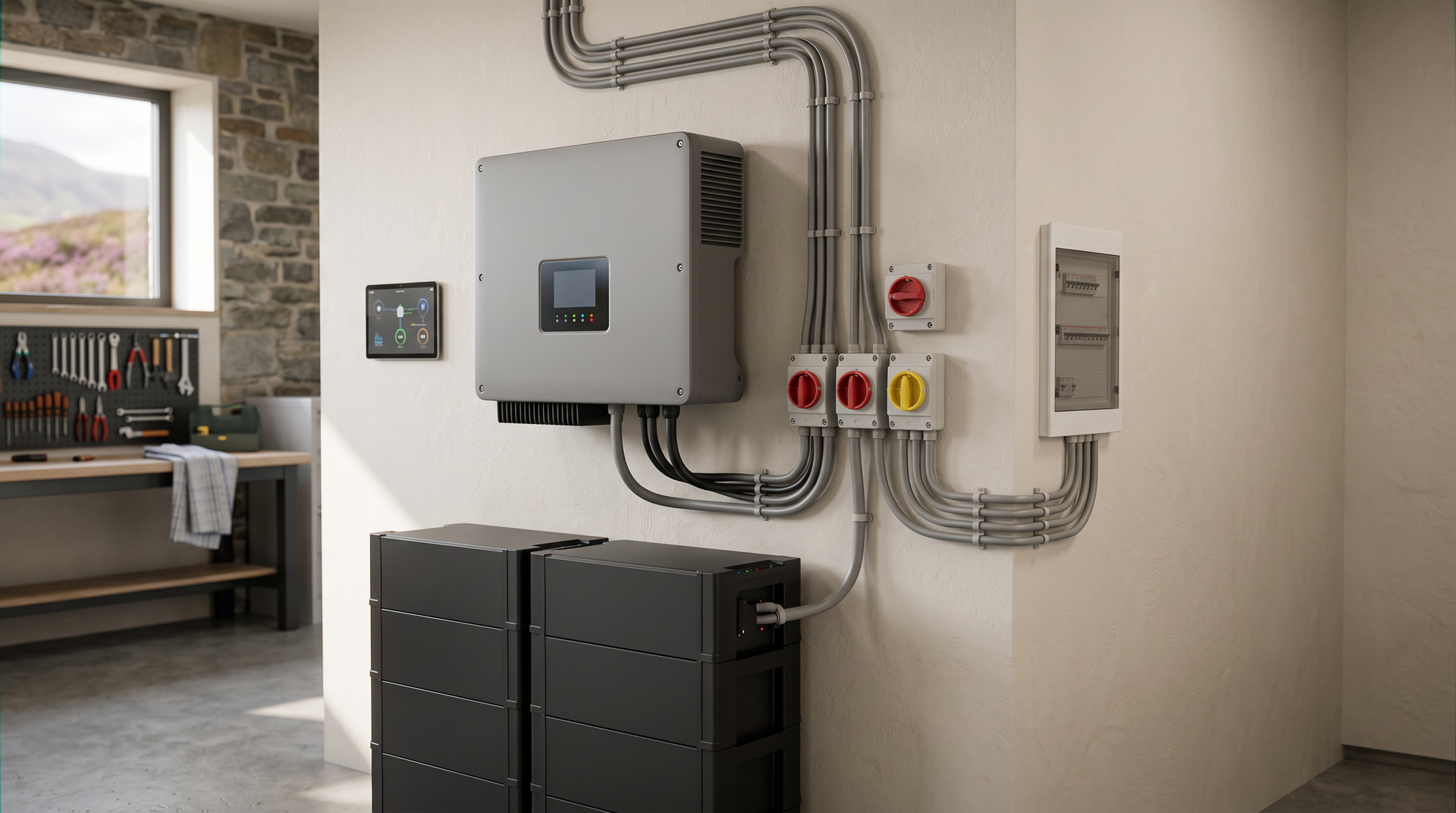
A battery system combines cells, battery management, power electronics, protection, metering and software. It decides when to charge, when to discharge and how much power can safely flow.
Monitoring detects solar generation, household demand, grid import and export so the controller understands the energy balance.
The battery stores selected surplus solar electricity or grid electricity when the configured tariff strategy permits.
Stored energy is converted back into usable household electricity within the battery and inverter power limits.
The management system monitors temperature, voltage, current and state of charge to keep operation within approved limits.
Different Ways to Use Storage
A battery does not have to be installed with solar panels. The appropriate design depends on the energy source, tariff and outcome the homeowner wants.
Designing both together allows the installer to coordinate generation, storage, inverter architecture, metering and controls as one system.
A battery can be added to an existing solar installation, but compatibility, warranty, inverter arrangement and monitoring need to be checked.
A household without solar may charge during lower-price periods and discharge when electricity costs more, subject to tariff and system controls.
Solar, battery storage, EV charging and a heat pump can be coordinated, but competing electrical loads and supply limits must be designed properly.
Capacity Is Only Half the Story
A battery described as “10kWh” does not necessarily deliver 10kWh at any rate the household chooses. Capacity and power describe different limits.
The total stated energy capacity before operational limits are considered.
The portion normally available after the manufacturer’s protected reserve.
How quickly the system can charge or supply household loads, measured in kW.
Some electricity is lost while charging, storing and converting energy back for use.
Sizing should consider typical overnight demand, solar surplus, tariff windows, major loads and how often the proposed capacity can be used productively.
Home Battery Costs in 2026
Energy Saving Trust currently uses an indicative figure of around £4,600 for a 5kWh battery system, while published ranges vary widely according to capacity, power and installation scope.
A cheap price for a large headline capacity may still offer poor value if usable capacity, discharge power, warranty or compatibility are weak.
Temporary VAT Relief
for qualifying installations under the temporary current rules.
Qualifying installations of electrical battery storage in residential accommodation are currently included within the temporary zero rate for eligible energy-saving materials.
Under the rules in force when this guide was reviewed, the temporary zero rate runs until 31 March 2027, after which qualifying installations are scheduled to revert to the reduced rate of 5%.
Check Current HMRC VAT GuidanceSavings and Financial Value
A battery can increase flexibility, but it does not automatically create a short payback. Current research indicates that adding storage to solar may not always recover its cost within the battery’s expected life, especially where export tariffs are attractive.
| Factor | Potential benefit | What can weaken the case |
|---|---|---|
| Solar surplus | Stores generation that would otherwise be exported. | Too little regular surplus or a strong export tariff. |
| Evening demand | Replaces higher-priced grid imports after solar production falls. | Low evening use or a battery that is too large. |
| Time-of-use tariff | Allows charging in cheaper periods for use at higher-price times. | Small tariff spread, changing terms or poor control configuration. |
| Heat pump or EV | Higher electrical demand can create more opportunity to shift energy. | Battery power too low to support major loads effectively. |
| Export strategy | Some tariffs reward controlled import and export behaviour. | Eligibility restrictions, automation limits or tariff changes. |
Tariffs and Intelligent Control
Time-of-use and dynamic tariffs can make grid charging useful, particularly in winter or for homes without solar. The control strategy must match the tariff and household demand.
Charge during a defined lower-cost period where the tariff provides one.
Reserve enough energy for the household without filling capacity unnecessarily.
Avoid charging fully before a day when solar surplus is expected.
Confirm whether the chosen tariff allows or rewards battery export.
Tariffs change. A system should remain useful even if one attractive product is withdrawn or its conditions are revised.
Power Cuts and Resilience
Not automatically. Many standard grid-connected batteries shut down during a power cut. Backup requires specifically designed equipment that safely isolates selected circuits from the network.
The system needs a defined off-grid or emergency output with sufficient power for the intended appliances.
Many homes protect essential loads such as lighting, refrigeration, communications or heating controls rather than the entire property.
Energy must remain in the battery when the outage begins; using all stored energy for bill savings leaves no backup reserve.
Solar cannot necessarily recharge the battery during a power cut unless the system is expressly designed and configured for that operation.
System Architecture
Neither arrangement is universally best. The decision depends on whether solar already exists, equipment compatibility, conversion path, backup requirements and future plans.
| Arrangement | Typical application | Points to consider |
|---|---|---|
| DC-coupled | Often designed with a new solar installation using a compatible hybrid inverter. | Potentially fewer conversion stages when storing solar; equipment compatibility is central. |
| AC-coupled | Often useful for retrofitting storage alongside an existing solar system. | Flexible integration but includes separate conversion equipment and associated losses. |
| All-in-one system | Integrated battery and inverter product with manufacturer controls. | Simpler packaged approach, but replacement and expansion options may be product-specific. |
Location, Protection and Fire Safety
A convenient empty wall is not enough. The installer must consider manufacturer instructions, current electrical and battery standards, fire safety, temperature, moisture, impact, ventilation, access and escape routes.
Confirm the permitted temperature range, moisture protection, ventilation and enclosure rating for the proposed product.
Assess separation, detection, containment, construction and the relationship to occupied rooms and escape routes.
Reduce risk from vehicles, tools, stored materials, flooding, accidental impact and unauthorised access.
Allow safe isolation, inspection, replacement and emergency response throughout the life of the system.
From Assessment to Handover
The installation should begin with energy data and finish with the homeowner understanding how the system operates.
Assess half-hourly or representative consumption, solar generation, tariff, export and future electrical loads.
Review solar equipment, inverters, metering, consumer equipment, earthing, supply and available monitoring.
Model usable capacity and power against the household’s charging and discharge opportunities.
Select a compliant site considering fire safety, environment, structure, cable routes and service access.
Coordinate the relevant Distribution Network Operator notification or application for the final architecture.
Complete battery, inverter, metering, protection and control work to the approved design.
Test safe operation, charge and discharge limits, monitoring, tariff schedule and any backup circuits.
Provide certification, warranties, emergency information and clear guidance on normal operation.
Lifespan, Cycles and Warranty
Battery warranties may be expressed through years, energy throughput, cycles, retained capacity or a combination of limits. The shortest applicable condition can determine the real protection.
The number of calendar years covered, subject to conditions.
A limit on total energy moved through the battery or charge cycles completed.
The minimum capacity the manufacturer promises at a defined point.
Temperature, internet connection, installation and usage rules that must be followed.
Check who provides the warranty, what labour is included, how claims are handled and what happens if the installer or manufacturer is no longer trading.
Questions and Answers
Straight answers to the questions homeowners ask before choosing a system.
Yes. A standalone battery can charge from the grid, commonly using a time-of-use tariff, and discharge during higher-price periods. The financial value depends on tariff spread, losses, usage and installed cost.
Energy Saving Trust currently uses an indicative figure of around £4,600 for a 5kWh battery system. Actual cost depends on power, equipment, electrical work, location, backup and integration.
It depends on overnight demand, solar surplus, tariff windows, major loads and the amount of energy that can be cycled usefully. Bigger is not automatically better.
kWh describes how much energy the battery can store. kW describes how quickly it can charge or provide power. Both affect how the system performs.
Only if the system has been specifically designed with sufficient backup output, isolation and suitable circuits. Many standard batteries do not provide outage power.
Not with every system. The inverter, controls and backup architecture must expressly support safe solar charging while isolated from the grid.
Yes, in many cases. Existing inverter, warranties, metering, network approval and manufacturer compatibility should be reviewed before selecting an AC- or DC-coupled solution.
Qualifying installed home battery systems are currently included in the temporary zero rate for eligible energy-saving materials until 31 March 2027 under the rules reviewed for this guide. Check the current HMRC position when ordering.
Service life varies with chemistry, temperature, cycling, depth of discharge and product quality. Review both the warranty term and its cycle, throughput and retained-capacity limits.
The location must comply with the product instructions and current safety standards. Temperature, moisture, impact, fire safety, ventilation, escape routes and service access all require assessment.
Battery systems normally require the appropriate Distribution Network Operator notification or application. The route depends on equipment, export behaviour and the wider generation system.
Some equipment and tariffs support this, but supplier rules, export eligibility, metering, network limits and system controls must all align.
Start With Your Energy Profile
Smart Group will review electricity use, solar generation, tariffs, electrical infrastructure and future plans before recommending a battery system.